


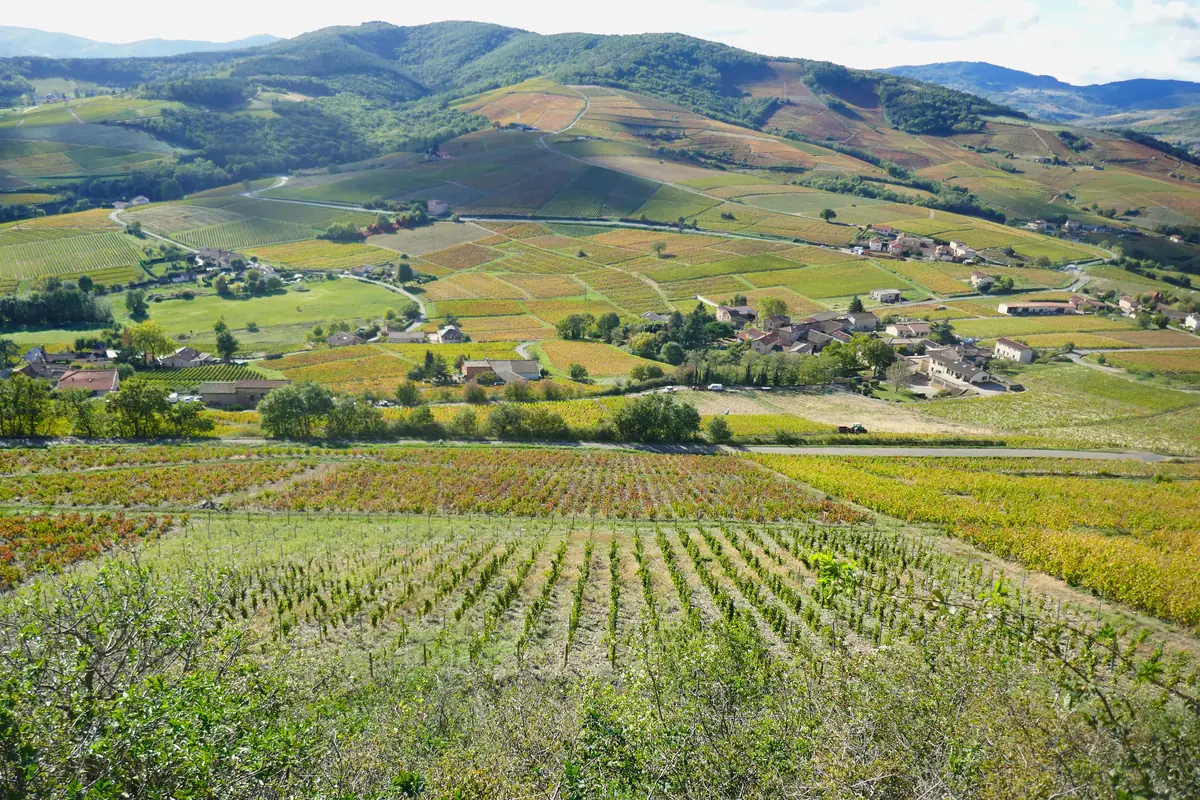
The Vineyard
A fragmented terroir.
A patient reconquest.
Rebuilding, parcel after parcel, the coherence of the original estate, on the pink granite that makes the great crus of Beaujolais.

01 Overview
Domaine Hauger Fargeaud today farms around fifteen parcels, for a total area of 13.7 hectares. Some of them were once part of the Château des Labourons; their reintegration draws on historical records, old appellation claims and soil analyses carried out across the whole vineyard.
The long-term aim: to rebuild, parcel after parcel, the coherence of the original estate.
02 The named plots

Les Labourons
Les Labourons is the high point. At around 400 metres of altitude, this plot is one of the highest in the Fleurie appellation. The old-timers used to say “up there, it doesn't ripen” and they weren't entirely wrong, in an era when the seasons were different.
Today, that altitude is a strength. In the face of climate change, the high parcels suffer less from heat and drought. The wines keep their freshness, their balance, their structure. They are naturally poised, with no need for correction.
Historical records claiming the Labourons plot under the former appellation attest to a long-standing recognition of this terroir. We did not invent its singularity; it has always been there.

Poncié
Poncié is one of the most emblematic named plots of Fleurie. Claims for a vinification specific to this site are attested here from very long ago, well before the notion of single-plot cuvées became commonplace.
The soils here are deeper, the rock ever-present. Ripening is steady, yields controlled. The wines carry the mark of a clean minerality and a fine density of fruit.

La Tonne
Neighbour to Poncié, La Tonne shows a close but distinct profile. Rich soils, generous ripeness, the wines are more enveloping, with an expressive aromatic structure and a fine ability to age.

03 The soils
The whole vineyard rests on pink granite, the geological bedrock of the great crus of Beaujolais. Soil analyses have been carried out on every parcel.
Beaujolais is one of the most thoroughly mapped French wine regions in terms of soil types: pink granite, sandy granite, manganese-bearing granite. These differences, however subtle, can be read in the wines.
04 The vines & replanting

The age of our vines
The average age of the vines is 35 to 40 years. The youngest are around ten years old. The oldest, in Moulin-à-Vent, were planted in 1944.
These old vines are a precious heritage. They give little, but they give true.
A long replanting cycle is under way. Chenin has been planted, around a hectare and a half of white. Some very old parcels, now barely productive, will be pulled up and replanted in the coming years.
Over the next ten years, the estate will keep a steady rhythm of pulling up and replanting. A long view, consistent with the idea that wine is built on time.
Within four years, Moulin-à-Vent wines will join the range. These vines are somewhat special: they belonged to M. Hauger's grandfather. A return to the roots, in the literal sense.
05 The single-plot approach
The single-plot cuvée is at the heart of our vision.
Even when the soils seem similar, altitude, exposure, the depth of the land and the microclimate create different profiles, sometimes radically so. Each parcel has its own logic, its own ripening dates, its own character.
The work adapts case by case. Some areas grow weedy quickly, the grass comes back easily, and call for a different approach. Others require more patience, fewer passes. We observe, we adjust, day by day.
To claim a named plot is to honour the singularity of a place. It is the estate's constant preoccupation.